§ Abstract
Existing skilled activity understanding / action quality assessment (AQA) datasets and methods face two key limitations: they rely primarily on explicit visual inputs (e.g., RGB and Pose data), overlooking implicit physiological dynamics such as muscle mechanics, and they model actions as monolithic, non-compositional patterns, limiting semantic richness. These constraints hinder fine-grained, biomechanically grounded feedback. To address this, we propose a paradigm that integrates multimodal sensing, structured representations, and compositional reasoning. We introduce MyoMechanix, a biomechanically grounded multimodal ecosystem for weight-loaded actions with strong internal–external alignment, enabling faithful coupling between motion and muscle activity. Expert-annotated, it comprises 7,500+ samples of 20 actions from 38 subjects, with synchronized multiview RGB video, 3D pose, sEMG, and additional physiological signals, forming the largest multimodal AQA benchmark to date. Building upon this sensing foundation, we construct the Fitness Knowledge Graph (FKG), which organizes annotations from field experts into structured relationships linking actions, phases, key steps, error types, and corrective feedback. This representation supports a compositional scoring and reasoning framework. To capitalize on the multimodal richness and structured representations, we develop a new modeling paradigm, CUBIST (Compositional Ontological Reasoning Engine), a framework that performs decomposition–analysis–recomposition over structured actions to enable fine-grained error attribution and feedback generation. We further establish the MyoMechanix-AQA benchmark and MyoMechanix-VideoQA, supporting tasks ranging from action quality assessment to error diagnosis and cross-modal reasoning, including a novel Video2EMG task. Extensive experiments demonstrate that CUBIST achieves state-of-the-art performance, multimodal fusion yields decisive gains, and the benchmarks present substantial room for future improvement.
§ Contents
1 Introduction & Motivation
Human motion is fundamentally governed by the neuromuscular system, in which observable kinematics emerge from complex coordination patterns of muscle activation. Due to the redundancy of the musculoskeletal system, visually similar movements can arise from substantially different internal control strategies — some of which may compromise safety and performance. Existing Action Quality Assessment (AQA) research remains limited: it primarily concentrates on exteroceptive visual inputs, struggles to capture implicit physiological states, treats actions as monolithic patterns, and relies on datasets with inconsistent quality and coarse-grained annotations.
Core Contributions
-
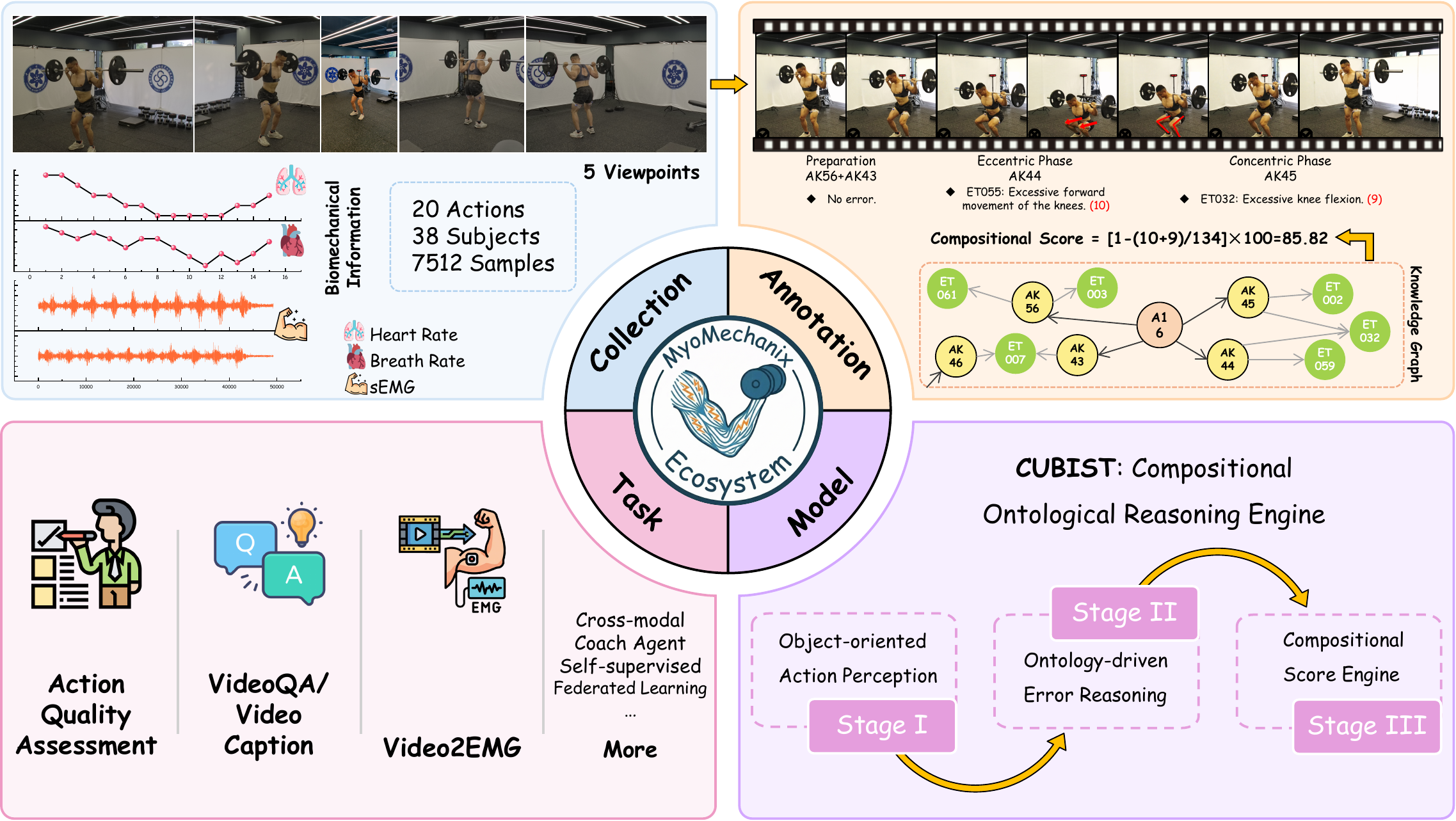
MyoMechanix Dataset 7,500+ samples across 20 weight-loaded actions from 38 subjects — synchronized 5-view RGB video, 3D pose, sEMG, heart rate & respiratory rate. The largest multimodal AQA benchmark.
-
Fitness Knowledge Graph (FKG) Formalizes actions as structured representations — decomposing each into hierarchical phases, ordered key steps (AKs), error types (ETs), and corrective feedback (FBs). Enables compositional, penalty-based scoring.
-
CUBIST Model Compositional Ontological Reasoning Engine — performs decomposition→analysis→recomposition over structured actions, producing interpretable error attribution and corrective feedback.
-
Three Benchmarks MyoMechanix-AQA (4 split protocols), MyoMechanix-VideoQA (30,048 QA pairs), and Video2EMG — a novel cross-modal task predicting muscle activity from video.
★ System Overview
3 MyoMechanix Dataset
Design Principles
MyoMechanix focuses on weight-loaded compound exercises — 20 representative actions selected to cover both upper- and lower-body muscle groups, involve complex and injury-prone joints (shoulders, knees, hips), include free-weight actions requiring stabilization, and represent widely practiced exercises. 10 barbell + 10 dumbbell exercises ensure balanced evaluation across equipment types.
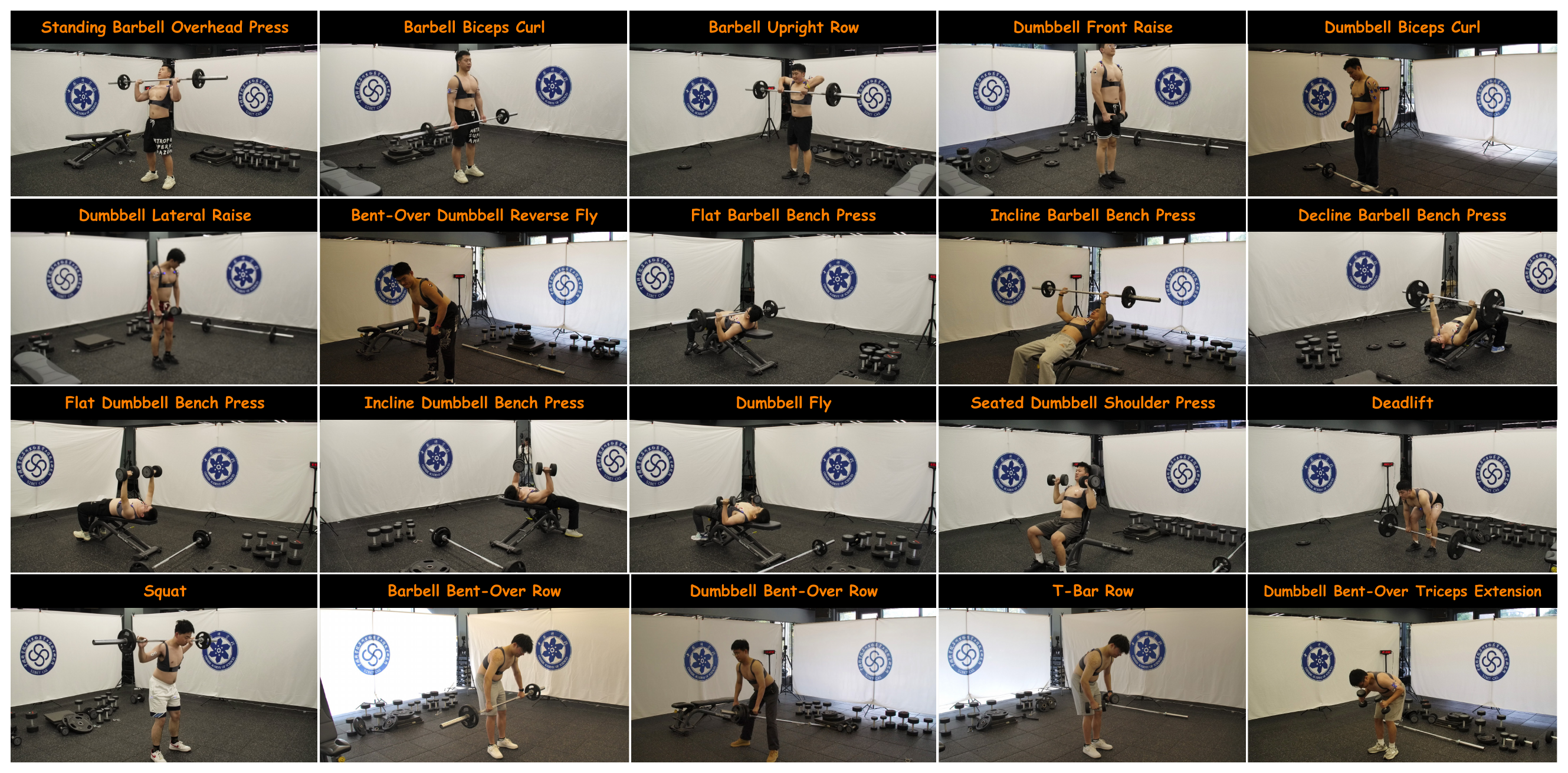
Multimodal Data Collection
(4 Cinema + 1 Phone)
@ 2,000 Hz
(10 Expert · 8 Amateur · 20 Novice)
40+ Hours Recording
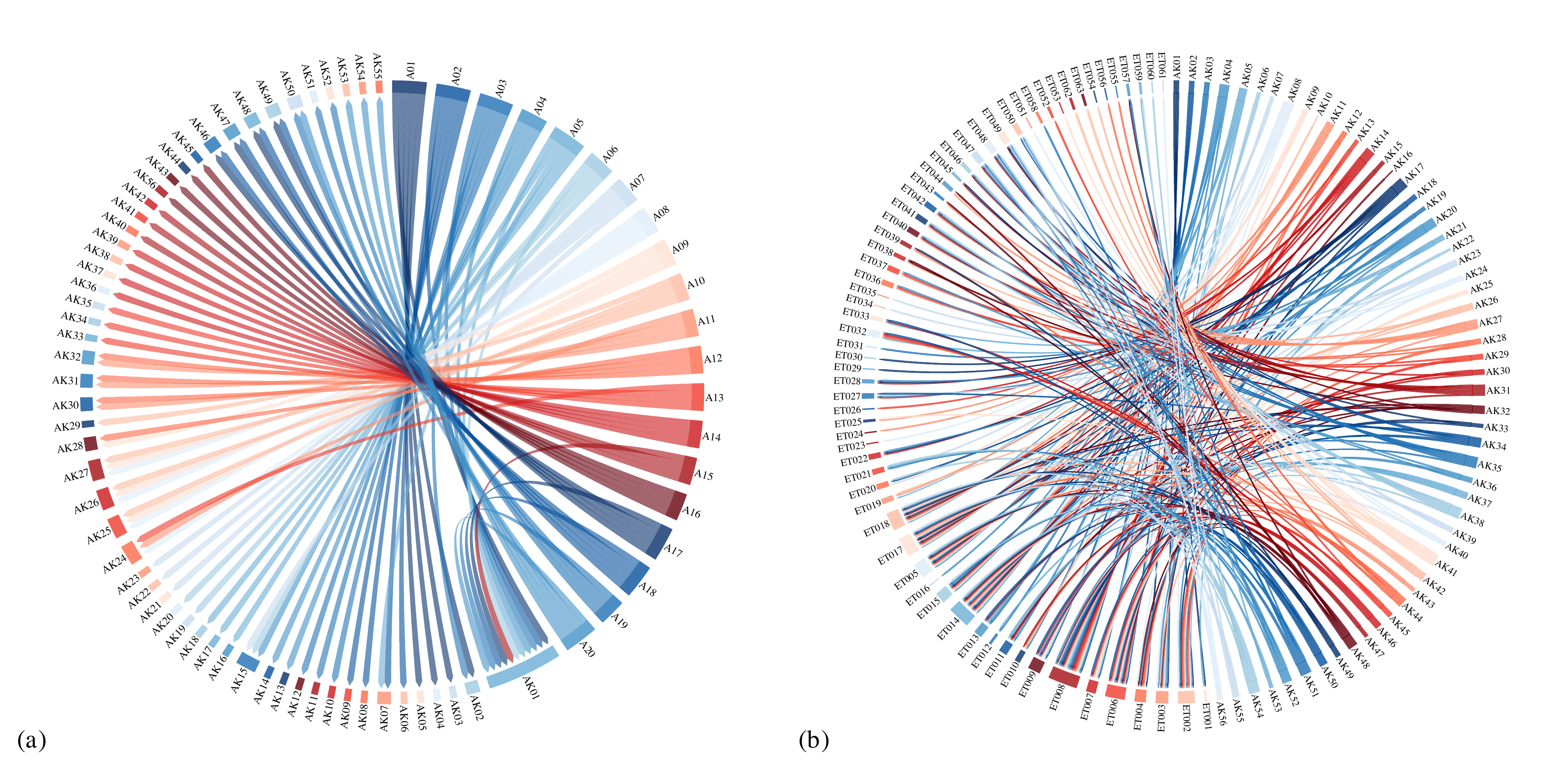
Fitness Knowledge Graph (FKG)
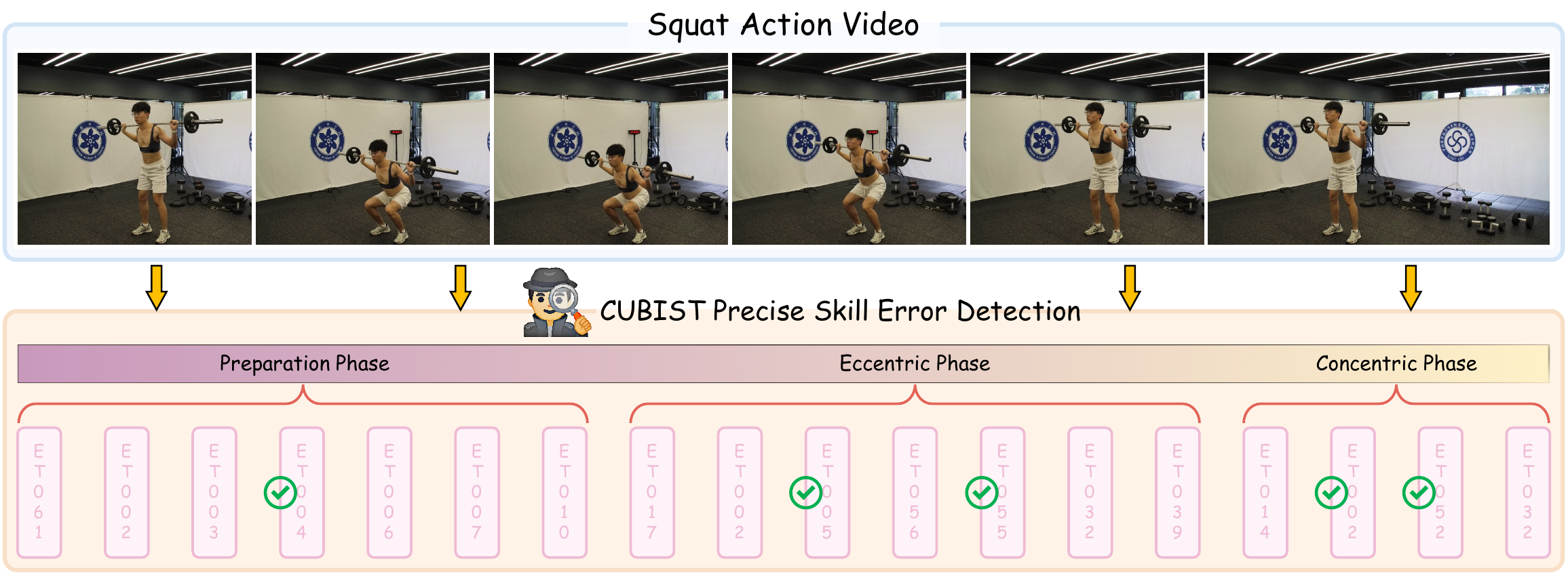
The FKG provides an ontology-like representation that formalizes weight-training exercises as biomechanically phased action representations. Each exercise is decomposed into three phases — Preparation, Concentric, and Eccentric — with ordered action key steps (AKs), phase-conditioned error types (ETs), and corresponding corrective feedback (FBs). Error severity is hierarchically weighted: joint safety (9–10), core stability (7–9), foundational posture (6–7), fine control (5), breathing (2).
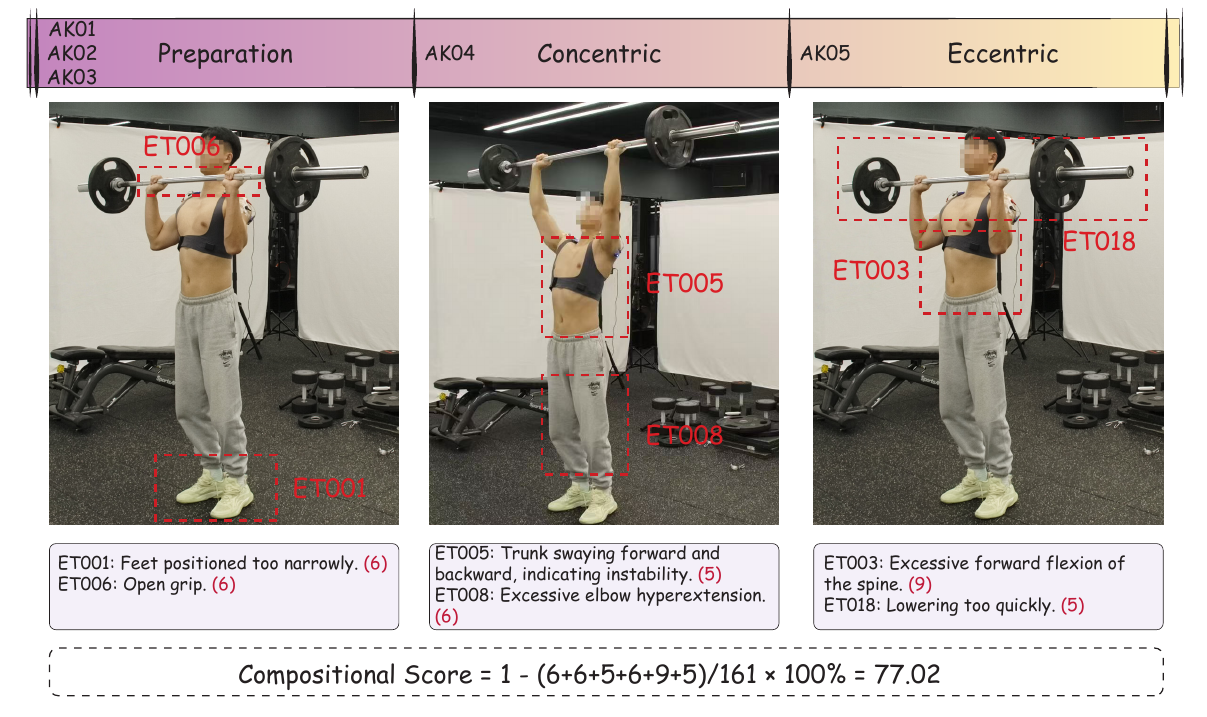
Compositional Scoring
The overall score is computed bottom-up: S = [1 − ΣWobserved / ΣWmax] × 100. This system separates mathematical complexity from annotation, ensuring both rapid labeling and full interpretability — in stark contrast to opaque holistic scoring approaches.
Annotation Statistics
(Range: 20–100)
(10.05 Sentences)
Per Sample
Per Sample
4 CUBIST Modeling Paradigm
CUBIST (Compositional Ontological Reasoning Engine) is inspired by the Cubist art movement's principle of decomposing complex objects, examining each part from multiple viewpoints, and recombining them to reveal underlying structure. It moves beyond monolithic black-box scoring toward interpretable, step-wise reasoning that closely reflects expert analysis.
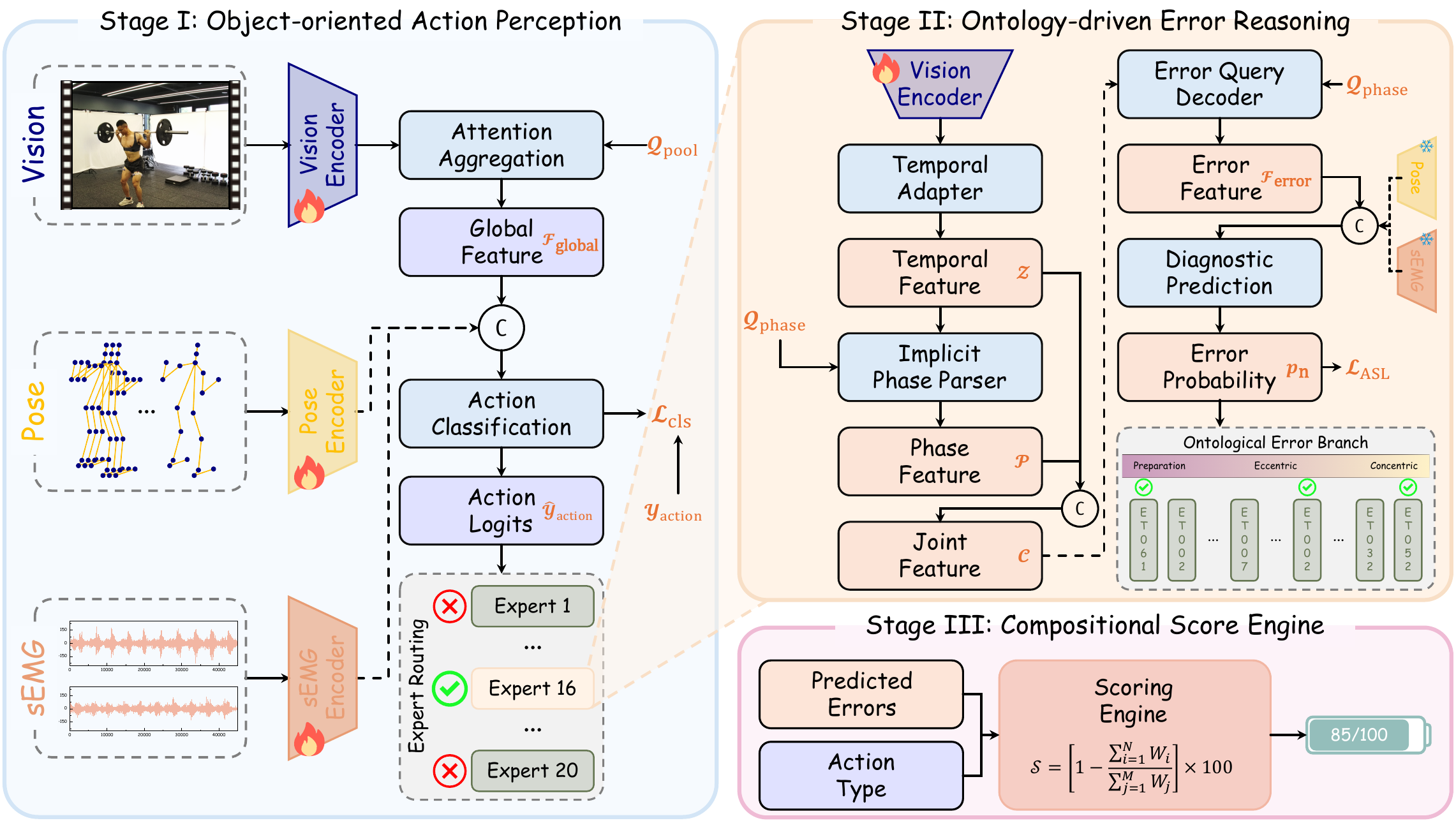
Three-Stage Progressive Design
Stage I — Action Perception-driven Expert Routing: A spatiotemporal video encoder with attention-based pooling classifies the action and routes the input to the appropriate action-specific expert network. Built on a ViT backbone with trilinear-interpolated positional encoding for up to 103-frame videos.
Stage II — Ontology-driven Error Reasoning: A temporal adapter recovers native spatiotemporal topology, an implicit phase parser discovers action phases without manual annotations, and a phase-aware error query decoder uses Mixture-of-Experts (MoE) architecture to predict fine-grained error probabilities. Asymmetric loss handles the high-dimensional, sparse multi-label nature of error detection.
Stage III — Compositional Scoring Engine: A deterministic neuro-symbolic module that applies annotation-defined error weights and the compositional scoring formula — introducing zero additional learnable parameters. The final score is directly attributable to interpretable error concepts, improving transparency at both reasoning and output levels.
Multimodal Fusion Strategy
CUBIST employs a feature-disentangled late-fusion design that avoids prematurely forcing heterogeneous modalities (RGB, 3D Pose, sEMG) into a shared representation space. Each modality develops task-relevant representations independently before integration, preserving modality-specific discriminative characteristics while reducing cross-modal gradient interference.
5 Experiments & Results
Three Benchmark Tasks
4 Split Protocols
4 Reasoning Categories
Novel Task
AQA Results — Vanilla Split
| Method | Modality | ρ ↑ | R-ℓ₂ ↓ |
|---|---|---|---|
| I3D-MLP | RGB | 0.4817 | 5.4521 |
| CoRe | RGB | 0.6832 | 3.2745 |
| TPT | RGB | 0.6904 | 3.2734 |
| HGCN | RGB | 0.6817 | 3.0156 |
| MCoRe | RGB | 0.6984 | 3.0156 |
| T2CR | RGB | 0.7217 | 2.8233 |
| DAE | RGB | 0.7431 | 2.6500 |
| CUBIST (Ours) | RGB | 0.7829 | 2.1542 |
CUBIST achieves new SOTA on unimodal RGB evaluation.
AQA Results — Multimodal Fusion
| Configuration | Modalities | ρ ↑ | R-ℓ₂ ↓ |
|---|---|---|---|
| DAE (SV) | RGB | 0.7431 | 2.6500 |
| SV + Pose | RGB + Pose | 0.7954 | 2.1002 |
| SV + Pose + EMG | Full (Single View) | 0.8297 | 1.8210 |
| DAE (MV) | Multi-View RGB | 0.7861 | 2.4320 |
| MV + Pose + EMG | Full (Multi-View) | 0.8561 | 1.5492 |
| CUBIST (MV + Pose + EMG) | All Modalities | 0.8836 | 0.7418 |
Progressive multimodal fusion yields consistent gains. CUBIST(MV+Pose+EMG): +18.91% ρ over DAE, +12.86% over unimodal CUBIST.
VideoQA Results
Fine-tuning Qwen2.5-VL-3B (LoRA) achieves substantial gains: BLEU 0.0415 → 0.1970, CHRF++ 39.53 → 52.00. However, score prediction accuracy remains challenging — R-ℓ₂ error decreases by less than 2%, suggesting that numerical reasoning in VLMs remains a significant open problem. Current VLMs still have ~50% room for improvement in text generation and up to 80% in score prediction.
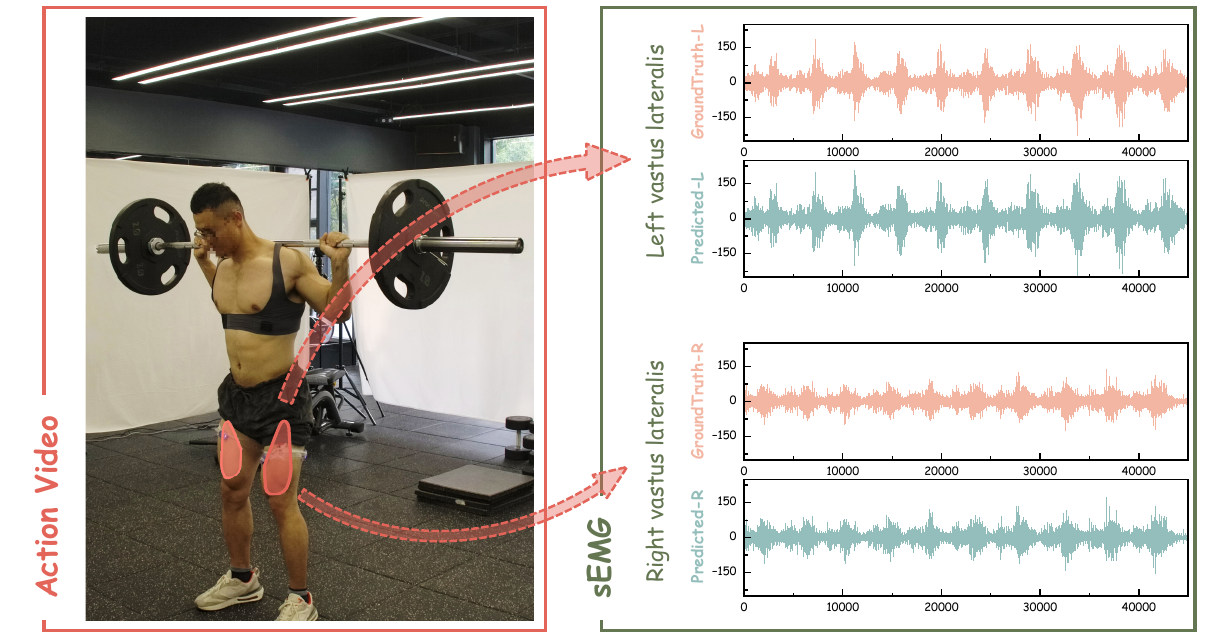
Video2EMG Results
The best configuration (ViT + SVR) achieves MAE = 0.1465, RMSE = 0.1882, CCP = 0.4345 (moderate waveform alignment). Performance degrades significantly under cross-subject and cross-view protocols, highlighting the difficulty of cross-modal physiological inference — leaving approximately 56% room for future improvement.
6 Conclusion
We introduced MyoMechanix, a biomechanically grounded multimodal ecosystem for skilled activity understanding and coaching, establishing a compositional paradigm for action quality assessment that moves beyond purely visual, monolithic action modeling. Three key findings: (i) effective AQA benefits from integrating latent biomechanical signals with visible motion cues; (ii) language-grounded reasoning over structured action knowledge enhances fine-grained VLM understanding; and (iii) promising Video2EMG results suggest a path toward estimating muscle dynamics from accessible visual observations. Despite these advances, MyoMechanix remains a challenging benchmark, motivating future research in cross-subject generalization, richer causal biomechanical modeling, and integration with embodied systems.
Acknowledgement
Supported by the Suzhou Basic Scientific Research Project (SSD2024013), the Doctoral Student Program of the Young S&T Talents Cultivation Project, CAST. Fast Move Technology is especially acknowledged for providing sEMG devices.
§ BibTeX Citation
If you find this work useful, please cite:
@article{yin2026myomechanix,
  title     = {MyoMechanix: Biomechanically-Grounded Compositional
               Skilled Activity Understanding and Coaching},
  author    = {Yin, Hao and Parmar, Paritosh and Gu, Lijun and
               Xu, Lin and Guo, Tianxiao and Liu, Xiujin and
               Zheng, Tianyou and Zhang, Yang and Fu, Weiwei},
  journal   = {Under Review},
  year      = {2026},
  url       = {https://github.com/HaoYin116/MyoMechanix}
}